Kutch Meets Kanchivaram: Ahir Embroidery on Silk
Culture. Colours. Craftsmanship.
Three words that define India! It is a country where art and craft flourish in their most beautiful forms. Every region has its rhythm, its hands, its way of telling stories through thread and weave.
Kutch, in Gujarat, is one of those places where tradition still lives in its truest form. The region is known for its rich, rooted crafts, from weaving to hand embroidery. It is practised by communities like the Ahir, Rabari, and Mochi. Among them, Ahir embroidery stands out for its bold stitches, vibrant colours, mirrors that catch the sun, and motifs inspired by the world around them, such as birds, animals, flowers, and life itself.
It began with a question like that… what if the joyful storytelling of Kutch could find a new home on the quiet grace of Kanchivaram silk?
What happens when two worlds of craft, one born in the desert, the other in the temple town, find each other on the same thread?
That’s where Tulsi Madras began this journey to bring together two traditions that speak different languages but share the same devotion to craft. Kutch embroidery, passed down through generations of women, finds a new rhythm on silk. The result is a collection that feels rooted yet new, nostalgic yet alive.
Ahir Embroidery – The Soul of Kutch
In the dry heartland of Gujarat, where the desert air meets the earth, embroidery is more than an art; it is a way of life. Among the many communities that call Kutch home, the Ahirs have carried forward one of its most distinctive crafts. Their roots trace back to pastoral times, to the stories of Lord Krishna and his cowherd clan, people known for their sense of joy, movement, and expression. That same spirit of playfulness lives on in their embroidery.
In Kutch, embroidery doesn’t start with a sketch. It starts with memory. The stitching begins with the Saankdi stitch, which traces the outline. This guides the flow of the design. The Vaano (herringbone) fills the shapes with textured depth. Tiny Sedhphool knots bloom into buds. While Bakhiyo and Daano add finishing touches only visible up close. Between these stitches, the mirrors (Aabhla) are placed like fragments of sunlight, held in place with a six-point star stitch. Traditionally, it is believed that these mirrors reflect happiness and deflect negativity.
The colours are joyous, bright reds, deep greens, mustard yellows, and cobalt blues. No two pieces are the same. Patterns grow as they wish, sometimes symmetrical, sometimes not. That’s their beauty, the small imperfections that make them human.
And when this craft, born in the courtyards of Kutch, finds its way to the luminous surface of Kanchivaram silk, it feels like poetry meeting discipline. The wild meets the refined. The story finds its frame.
Motifs and Colours – Stories in Thread and Light
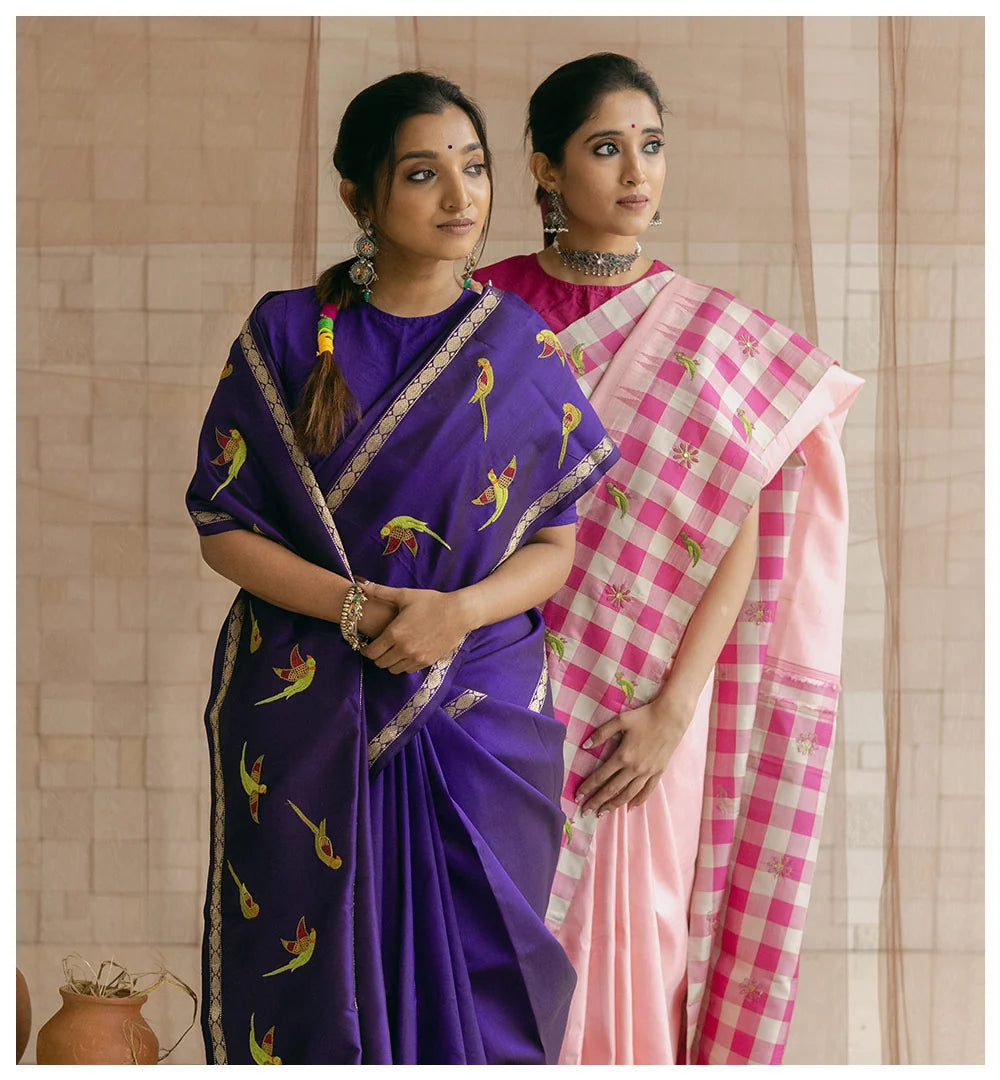
Kutch embroidery speaks in symbols. Flowers, vines, birds, animals, and mirrors each carry a distinct meaning, weaving together a narrative of rural life. Among these, the parrot, or sudo, is a familiar companion in village courtyards, a cherished symbol of joy and conversation. While flowers represent growth and grace, the parrot brings a sense of lively spirit to the fabric.
At Tulsi Madras, the parrot is more than just a motif; it has found a new rhythm in this collection. Here, parrots perch playfully across panels of silk, their presence echoed by hand-embroidered blooms that suggest the movement of flight. Mirrors are scattered like tiny sparks, catching movement as the saree sways.

Colour brings it all together. Traditionally, Kutch work bursts with red, green, yellow, purple, and black… bold and fearless. But on Kanchivaram silk, we let the palette breathe. Greens and reds remain, now softened by pinks, oranges, and gentle blues. It’s still vibrant, but with a whisper of calm. It is like when the folk song turns into a raga.
Together, these motifs and hues tell a story of balance. They speak of heritage, but they wear easily today.
Fusion at Its Finest – Kutch Meets Kanchivaram
This collection is more than a simple blend; it is a meeting of two distinct temperaments. It is where the rhythmic, vibrant energy of Northwest India meets the refined structure of the South. In this creative exchange, two legacies find a way to dance together in perfect harmony.

Traditional Kutch embroidery is celebrated for its dense, colour-rich patterns. Within these intricate landscapes, the Sudo (parrot) is often nestled among winding creepers and shimmering mirrors, sometimes nearly hidden by the complexity of the design. For our latest campaign, we wanted to shift that perspective. Our vision was to bring a contemporary, minimalist touch to this heritage craft. By stripping back the density, we allowed the Sudo to emerge as a singular, striking statement—giving the traditional motif modern breathing space.

At Tulsi Madras, we ensured that every saree in this collection carries two heritages: the earthy confidence of Kutch and the poised grace of Kanchivaram. The result is a beautiful harmony.
Some pieces stay with you. You reach for them not just to dress up, but to remember a texture, a story, or a feeling. These sarees are of that kind. Each piece carries a story lived: the colours of Kutch, the discipline of Kanchivaram, and the patience of hands that never rush their craft. These sarees aren’t mass-produced or trend-driven; they are slow, deliberate, and personal. They carry the hum of voices, the warmth of hands, and the pulse of two cultures meeting halfway. To wear one is to carry the story of women who stitch by instinct, of weavers who work by rhythm, and of colours that bridge regions and generations.
It’s a celebration of craft that refuses to fade, only evolve. Step into this world of silk and sunlight. Explore the Ahir-Kanchivaram collection at Tulsi Madras, and let your saree move with the same grace as the hands that made it.
Source: Under the Embroidered Sky: Embroidery of the Ahirs of Kutch